
Microfluidics Cartridge Injection Molding: The Next Frontier in Diagnostics & Life Sciences (2025–2030)

Updated: Jan 13
The microfluidics market is experiencing explosive growth, valued at approximately $40 billion in 2025 and projected to exceed $75 billion by 2030, expanding at a 20%+ compound annual growth rate. This transformation reflects a fundamental shift in how diagnostic, pharmaceutical, and biotech companies approach sample analysis, drug discovery, disease modeling, and precision medicine. What was once a research novelty is now commercial reality: point-of-care cartridges, lab-on-a-chip platforms, organ-on-chip systems, single-cell analysis devices, and automated bioprocessing are becoming standard tools across clinical and research settings. For medical device and diagnostics OEMs, this market acceleration creates both urgency and opportunity. Microfluidic devices demand precision-molded components engineered for nanoliter and picoliter-scale accuracy, optical clarity, biocompatibility, and scalability. TN Plastics, with FDA-registered cleanroom capabilities and deep expertise in medical and diagnostic components, is positioned to support OEMs capturing this next frontier.
What is Microfluidics?
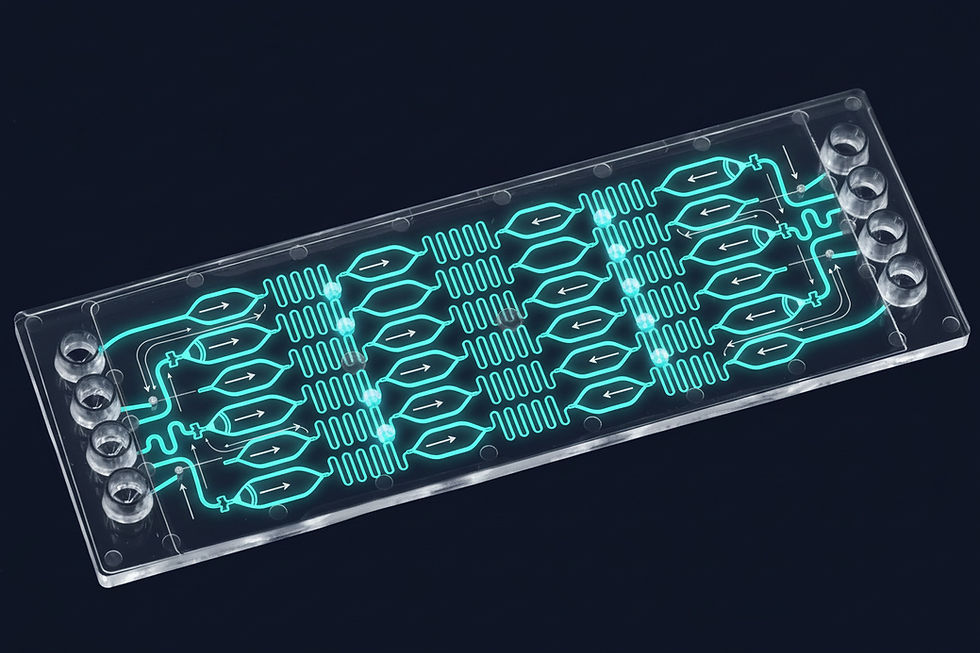
Microfluidics is the precise control and manipulation of minute fluid volumes—often nanoliters or picoliters—through micro-scale channels to perform complex laboratory processes on a single chip. By integrating sample preparation, reaction, separation, and detection into one miniaturized system, microfluidic platforms deliver faster results, lower reagent costs, and higher analytical sensitivity compared to conventional benchtop methods.
The elegance of microfluidics lies in integration: what once required multiple sequential steps, multiple instruments, and skilled technicians can now happen automatically, predictably, and at microscale on a single disposable cartridge or chip. This capability transformation is driving adoption across virtually every life science segment.
Key Growth Drivers: Why Microfluidics is Exploding Now
Market expansion is not generic—it reflects genuine advances in specific applications that are moving from R&D into high-volume commercial production.
1. Diagnostics Evolution: Speed, Cost, Accessibility
Point-of-care (POC) molecular testing is moving from centralized laboratories to clinics, urgent care, pharmacies, and homes. Microfluidic cartridges enable rapid nucleic acid detection—critical for pathogen identification, genetic testing, and real-time disease monitoring. These devices cut turnaround times from hours to minutes, reduce reagent consumption by 90%+, and minimize sample volumes from milliliters to microliters. IVD & Diagnostics represents the largest segment in 2025 at $12 billion (40% of the total market), driven by lateral flow integration, cartridge-based molecular assays, and the continued shift to decentralized testing.
2. Biopharma & Cell Therapy: Single-Cell Precision and Automation
Understanding single-cell behavior is revolutionizing immunotherapy, gene therapy, and cell manufacturing. Microfluidic platforms isolate, analyze, and manipulate individual cells with unprecedented precision, enabling researchers to identify rare immune cells, optimize manufacturing workflows for cell therapies, and screen billions of variants in parallel. Organ-on-chip technology—where human tissue physiology is mimicked in miniaturized, controlled microfluidic devices—is rapidly replacing animal models in drug testing and toxicology. This segment ($6 billion in 2025, 20% share) is growing fastest as biopharmaceutical companies invest heavily in cell therapy platforms and advanced manufacturing.
3. NGS & Genomics: Democratizing Sequencing
Next-generation sequencing relies increasingly on microfluidic platforms for droplet-based sequencing, sample preparation, and automated library prep workflows. As genomic testing costs decline and clinical applications expand—from rare disease diagnosis to infectious disease surveillance to population genomics—microfluidic-enabled NGS workflows are becoming essential infrastructure in clinical and research labs worldwide. The Genomics & Sequencing segment ($4.5 billion in 2025, 15% share) is characterized by high-complexity, high-volume consumable demand.
4. Consumables Expansion: Sustained Volume Opportunity
Perhaps most important for contract manufacturers: every POC diagnostic, single-cell platform, NGS system, and lab automation tool generates demand for disposable microfluidic cartridges, chips, chambers, and consumable components. Unlike reusable equipment, these parts must be replaced with every test, creating sustained, predictable high-volume demand. Environmental, Food & Industrial testing ($3.5 billion, 12% share) and Other Emerging Applications ($2.5 billion, 8% share) represent the fastest-growing segments as microfluidics expands beyond healthcare into water quality monitoring, pathogen detection in food supply chains, and industrial quality control.

Emerging Trends Shaping the 2025–2030 Period
Miniaturization and Reagent Cost Reduction
Devices are becoming smaller and more precisely engineered, moving diagnostics from centralized labs to decentralized POC settings while dramatically reducing reagent consumption. This requires precision molding of compact cartridges and disposable chips with micron-scale features, optical clarity, and chemical compatibility—exactly what cleanroom, precision injection molding delivers.
Smart Systems: AI, Sensors, and Data Integration
Microfluidic devices are increasingly paired with AI-driven analysis, integrated biosensors, and cloud connectivity. This convergence drives demand for sophisticated device designs that seamlessly integrate fluidic, electronic, and optical components—requiring close collaboration between OEMs and molding partners throughout development and scale-up.
Beyond Healthcare: Expansion into Testing and Quality
While healthcare remains dominant, microfluidics is rapidly expanding into environmental testing (water quality, pathogen detection), food safety (contamination, adulterants), industrial quality control, and chemical analysis. Each application creates new consumable demand and opportunities for specialized molding partners capable of supporting diverse material and design requirements.
Strategic Opportunity for TN Plastics
OEMs are increasingly outsourcing microfluidic component production to cleanroom-certified partners capable of tight-tolerance injection molding, complex assembly, and scalable production—positioning specialized manufacturers as key enablers of the next generation of diagnostic and analytical devices.
What OEMs Need from Molding Partners
Cleanroom infrastructure: ISO Class 8 or better for contamination-sensitive microfluidic and diagnostic components
Precision and consistency: Micron-level tolerances and cavity-to-cavity repeatability across high-volume tools producing millions of disposable cartridges annually
Optical clarity and material expertise: Access to medical-grade, optically clear (transparent or translucent), biocompatible resins compatible with assay chemistries, reagents, and sterilization methods
Design collaboration: DFM reviews, mold flow analysis, gating optimization, and venting strategy to ensure manufacturability without compromising microfluidic functionality
Validation and regulatory support: IQ/OQ/PQ services and ISO 13485–aligned quality documentation supporting FDA submissions and device registration
Scalability: Demonstrated capacity to scale from pilot validation runs to millions of parts annually while maintaining dimensional and functional consistency

Why TN Plastics is the Right Partner
TN Plastics combines the specific capabilities microfluidics OEMs demand:
FDA-registered, ISO Class 8 cleanroom molding for contamination-sensitive diagnostic and microfluidic component production
Precision injection molding with statistical process control and automated inspection ensuring micron-level consistency across millions of parts
Material and optical expertise with access to 80+ plastic formulations through the Tsubaki Nakashima global network, optimized for microfluidic performance, biocompatibility, and clarity
Engineering collaboration from concept through production, including mold design, DFM analysis, and design optimization for manufacturability
Validation and quality infrastructure aligned with ISO 13485:2016 and FDA requirements, supporting regulatory submissions for medical and diagnostic devices
Scalable capacity supporting 1–50+ million injection molded components annually, with capacity to grow alongside customer demand
U.S.-based manufacturing (Michigan facility) for nearshoring benefits, reduced lead times, and responsive collaboration with North American OEMs
How OEMs Should Prepare to Capitalize on the Microfluidics Cartridge Injection Molding Wave
For OEMs planning to launch microfluidic products or scale existing platforms during 2025–2030, strategic supplier partnerships are critical.
1. Engage a cleanroom-capable molding partner early—during design phase, not after tool construction. Early collaboration ensures designs are optimized for both microfluidic performance and manufacturing consistency, reducing tooling changes and accelerating time-to-market.
2. Conduct comprehensive DFM reviews and mold flow analysis with your molder to optimize gating, venting, and filling patterns. Microfluidic function depends on precise channel filling and minimal weld line formation—these must be engineered into the tool.
3. Plan for scale from the beginning. Design tools, processes, and material specifications that can handle millions of parts annually while maintaining dimensional and functional consistency. Prototype tools optimized for small runs often fail at volume.
4. Consider dual-sourcing or backup capacity for critical cartridge and consumable components. Given the competitive intensity in microfluidics and the supply chain lessons of recent years, supply redundancy is strategic, not optional.
5. Build strong supplier partnerships with molders who understand microfluidics and invest in your product roadmap. Successful microfluidic scaling requires trust, transparency, and aligned incentives between OEM and molder.
Conclusion: Positioning for the Microfluidics Wave
The microfluidics cartridge injection molding market explosion is real and durable, driven by genuine advances in diagnostics speed, accuracy, cell biology precision, genomic accessibility, and industrial quality control. From POC cartridges valued at $12 billion today to emerging applications in food safety and environmental testing, the next five years will bring unprecedented demand for precision-molded microfluidic components.
OEMs that secure the right molding partners—those combining cleanroom capabilities, precision engineering, material expertise, design collaboration, regulatory alignment, and demonstrated scalability—will be best positioned to capitalize on this opportunity and establish market leadership in the next generation of diagnostic and analytical devices.
TN Plastics is purpose-built for the microfluidics era. Our FDA-registered cleanroom injection molding, precision capabilities, optical material expertise, design collaboration, ISO 13485 quality system, and proven medical device experience support OEMs at every stage: from early prototypes through validated, high-volume commercial production. If you are launching a microfluidic cartridge, scaling a lab-on-chip platform, manufacturing diagnostic consumables, or exploring the expanding opportunities in cell therapy, genomics, or environmental testing, we invite you to discuss how TN Plastics can accelerate your path to market and support your growth through 2030.
Ready to Discuss Your Microfluidic Component Needs?
Contact TN Plastics to explore how our cleanroom injection molding, precision engineering, and medical device expertise can support your microfluidic product development and scale-up.


